Subscribe to the BHH Newsletter and stay up to date on the latest news, events and opportunities of the BHH digital health ecosystem.


Recinte Modernista de Sant Pau
Carrer de Sant Antoni Maria Claret 167
08025 Barcelona, Spain
contact@barcelonahealthhub.com

Back
STAT-ON™ Study Confirms Parkinson’s Care Benefits
OCTOBER 13, 2025
Members' News
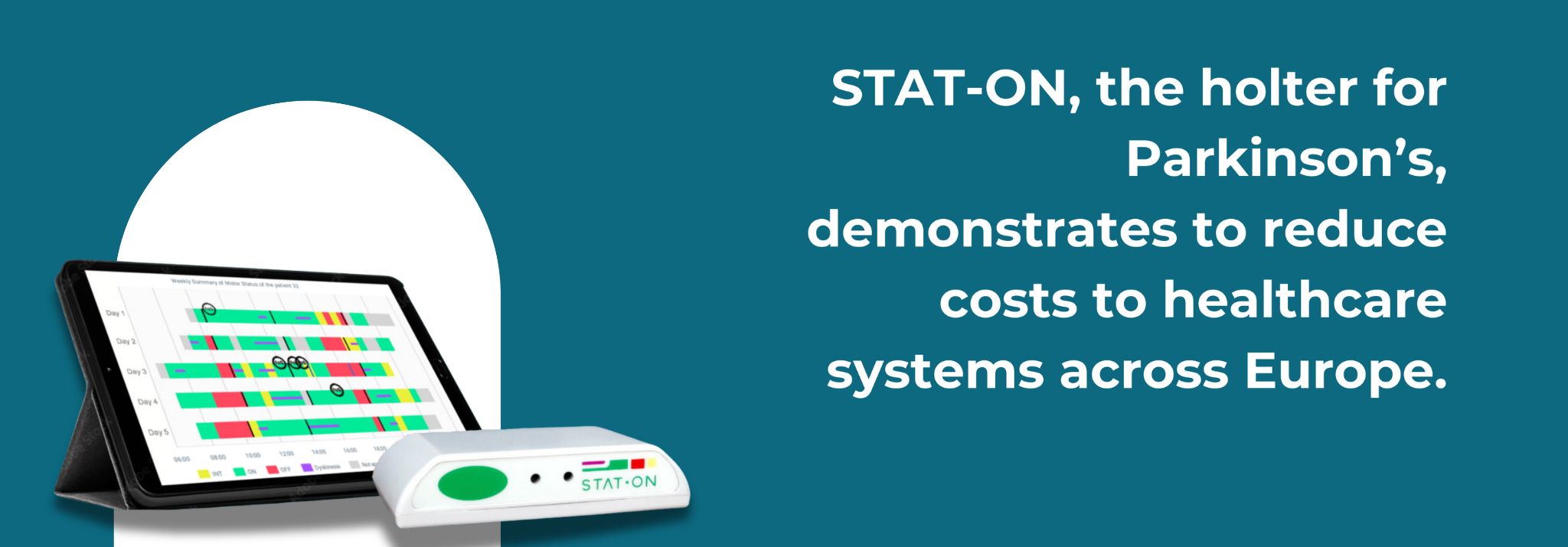
After three years of dedicated research and collaboration, the long-awaited cost-benefit study on STAT-ON™ has been officially published in PLOS ONE. This milestone marks a significant achievement for Sense4Care, reinforcing its mission to demonstrate how digital health technologies can create real, measurable value.
The study, titled “Improving Parkinson’s disease management through wearable technology: A cost-benefit perspective,” provides compelling evidence that the integration of STAT-ON™, a clinically validated wearable sensor for Parkinson’s monitoring, can simultaneously reduce healthcare costs and enhance patients’ quality of life.
The findings highlight the economic and clinical advantages of early detection and management of advanced Parkinson’s symptoms through continuous and objective monitoring. According to the study, annual savings could reach €137.8 million in Germany, €31.3 million in the United Kingdom, €19 million in Sweden, €4.2 million in Spain, and €1.9 million in Italy. These numbers illustrate not only the financial efficiency of implementing STAT-ON™ across European healthcare systems but also its potential to transform the standard of care for Parkinson’s Disease. By providing neurologists with continuous data on patients’ motor symptoms, the device enables timely treatment adjustments, helping to prevent hospitalisations, improve clinical outcomes, and ultimately foster a more sustainable healthcare model.
Authored by Daniel Rodriguez, Prof. Andreu Català, Prof. Joan Cabestany, and the Sense4Care team, the study underscores the company’s guiding principle: digital health only makes sense if it delivers measurable clinical and economic impact.
The publication in PLOS ONE is not only a scientific validation of STAT-ON™’s effectiveness but also a testament to Sense4Care’s commitment to advancing data-driven solutions that empower clinicians and improve patients’ daily lives. This achievement represents an important step forward in redefining Parkinson’s management through innovation, evidence, and empathy—showing that technology, when applied thoughtfully, can truly make healthcare both smarter and more human.
You may also like
See all

October 05, 2026
Members' News
September 21, 2026
Members' News
September 21, 2026
Members' News
September 11, 2026
Members' News
September 11, 2026
Members' News
July 17, 2026
Members' News
July 15, 2026
Members' News
July 15, 2026
Members' News
July 15, 2026
Members' News
July 10, 2026
Members' News


Recinte Modernista de Sant Pau
Carrer de Sant Antoni Maria Claret 167
08025 Barcelona, Spain
