Subscribe to the BHH Newsletter and stay up to date on the latest news, events and opportunities of the BHH digital health ecosystem.


Recinte Modernista de Sant Pau
Carrer de Sant Antoni Maria Claret 167
08025 Barcelona, Spain
contact@barcelonahealthhub.com

Back
TPM Science’s Strategic Approaches to Strong Regulatory Writing
MARCH 12, 2026
Members' News
In today’s global clinical development environment, regulatory operations function within a framework defined by the International Council for Harmonisation of Technical Requirements for Pharmaceuticals for Human Use (ICH) and enforced by authorities such as the U.S. Food and Drug Administration (FDA) and the European Medicines Agency (EMA). Within this landscape, documentation quality can directly influence review timelines, the number of clarification requests, and ultimately, regulatory outcomes.
Strong regulatory writing goes beyond compliance checklists. It translates scientific complexity into structured, coherent, and strategically aligned documentation that facilitates efficient assessment.
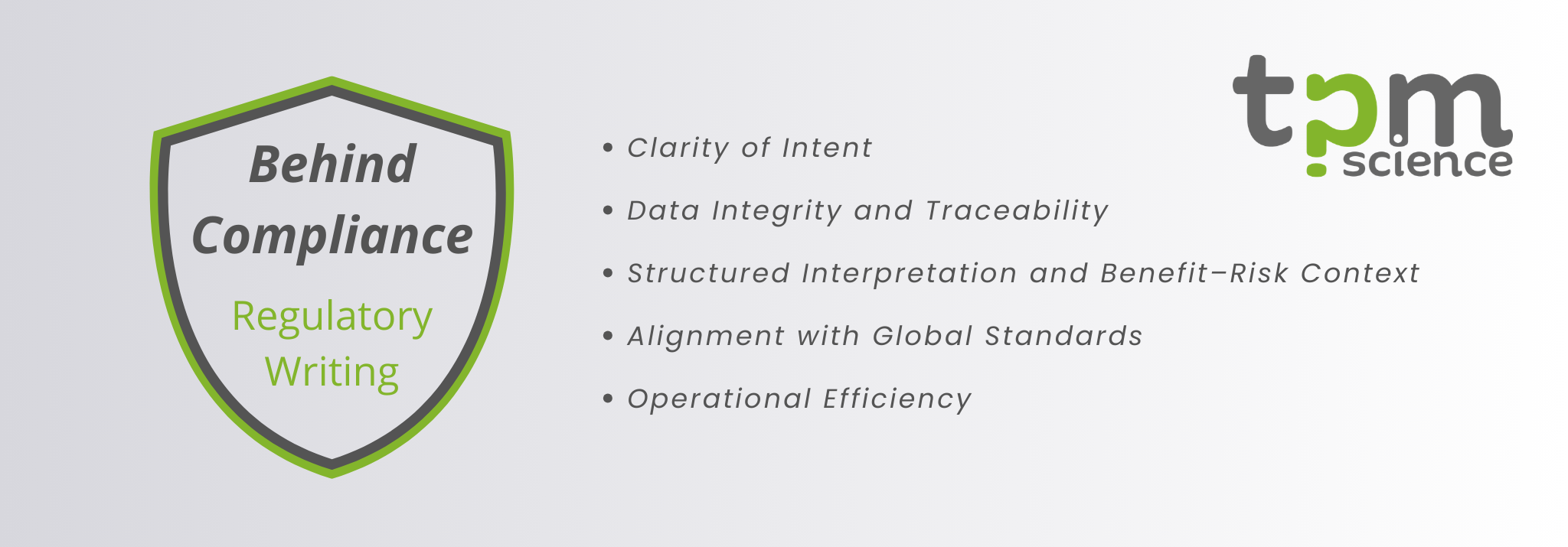
- Clarity of Intent
At its foundation, effective regulatory writing demonstrates clarity of purpose:
- Transparent articulation of study objectives and endpoints
- Explicit justification of study design and methodology
- Clear alignment between development strategy and clinical execution
Guidelines such as ICH E6(R3) on Good Clinical Practice and ICH E8(R1) on General Considerations for Clinical Studies emphasize quality-by-design principles and the importance of clearly defined objectives and critical-to-quality factors. When documentation reflects these principles, reviewers can more readily understand the scientific rationale underpinning a program.
- Data Integrity and Traceability
Regulators expect traceability from raw data to conclusions:
- Clear linkage between tables, figures, listings, and narrative text
- Consistency across the protocol, statistical analysis plan (SAP), and Clinical Study Report (CSR)
- Alignment between individual study reports and integrated summaries
Guidelines such as ICH E3 on Structure and Content of Clinical Study Reports provides a detailed framework for CSR organization, reinforcing the need for structured presentation and internal consistency. Clear cross-referencing and a consistent narrative help streamline the review process and reduce the likelihood of additional information requests.
- Structured Interpretation and Benefit–Risk Context
Data presentation alone is insufficient. Strong regulatory writing incorporates:
- Balanced discussion of efficacy and safety
- Transparent acknowledgment of limitations
- Contextualized benefit–risk evaluation
- Anticipation of potential regulatory questions
Both the FDA and EMA have issued guidance on benefit–risk assessment frameworks, underscoring the importance of clear reasoning in regulatory submissions. A well-crafted discussion section can proactively address concerns, reducing iterative queries during review cycles.
- Alignment with Global Standards
Global submissions demand structural precision. Regulatory documents must adhere to:
- ICH Common Technical Document (CTD) structure
- Electronic Common Technical Document (eCTD) formatting requirements
- Region-specific expectations without compromising core consistency
The CTD format, adopted across ICH regions, enables harmonized submissions. However, harmonization does not eliminate the need for strategic tailoring. Experienced writers understand how to maintain modular consistency while accommodating regional nuances.
- Operational Efficiency
High-quality regulatory writing also delivers operational value:
- Reduced revision cycles through clear first-draft quality
- Streamlined cross-functional collaboration
- Submission readiness aligned with development milestones
When writers engage early with clinical, statistical, and regulatory teams, documentation evolves in parallel with the program. This integration supports predictable timelines and mitigates last-minute bottlenecks.
Regulatory Writing as Strategic Infrastructure
For CROs, pharmaceutical sponsors, and investigators, regulatory documentation is not merely a deliverable — it is a strategic interface between scientific development and regulatory decision-making. Clear structure, traceable data, balanced interpretation, and operational discipline collectively strengthen credibility and efficiency. In this environment, partnering with an experienced regulatory writing team becomes a strategic advantage.
At TPM Science, the team combines scientific rigor, regulatory insight, and operational efficiency to deliver clear, submission-ready documentation aligned with global standards. By integrating cross-functional expertise with structured, high-quality writing processes, TPM Science supports CROs, pharmaceutical companies, and investigators in transforming complex clinical data into coherent regulatory narratives that facilitate confident review and informed decision-making.
Planning a regulatory submission? Connect with TPM Science to discuss how expert regulatory writing can support your development program: https://tpmscience.eu/contact-us/?whichservice=Papers
References
- International Council for Harmonisation of Technical Requirements for Pharmaceuticals for Human Use https://www.ich.org/
- U.S. Food and Drug Administration https://www.fda.gov/
- European Medicines Agency https://www.ema.europa.eu/
You may also like
See all

October 05, 2026
Members' News
September 21, 2026
Members' News
September 21, 2026
Members' News
September 11, 2026
Members' News
September 11, 2026
Members' News
July 17, 2026
Members' News
July 15, 2026
Members' News
July 15, 2026
Members' News
July 15, 2026
Members' News
July 10, 2026
Members' News


Recinte Modernista de Sant Pau
Carrer de Sant Antoni Maria Claret 167
08025 Barcelona, Spain
